Monday, 1 April 2013

PanSTARRS and Other Comets

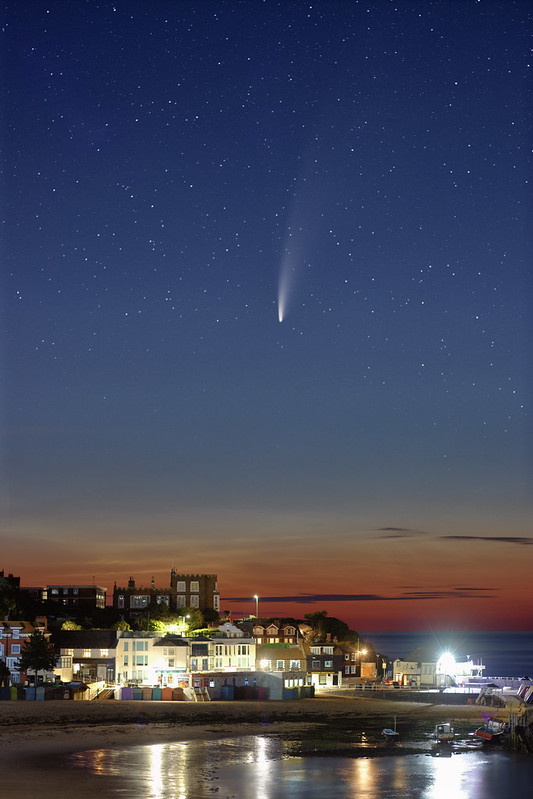
It was David H. Levy who said: "Comets are like cats; they have tails and they do precisely what they want," but in many ways Comet C/2011 L4 (PanSTARRS) did precisely what was expected of it, in managing (just about) to reach naked-eye visibility, while never coming close to attaining the prominence of mid-nineties wonders, Hyakutake and Hale-Bopp.

Comet C/2011 L4 (PanSTARRS)
Comet C/2011 L4 (PanSTARRS), Broadstairs, March 2013

After two failed attempts to see it, I first caught a glimpse of Comet PanSTARRS through a gap in the clouds on Wednesday 13 March, but it wasn't until the following Tuesday that the sky stayed clear long enough for me to get some images. As this is only the third comet I've photographed - after McNaught (arguably the first Great Comet of the digital age - for the Southern hemisphere at least) and Holmes (arguably the weirdest astronomical object of the digital age) - I was just pleased to get anything at all, but a potentially great comet could be waiting in the wings in the shape of C/2012 S1 (ISON), which will swing through the inner solar system later this year. I must stress the word "potentially" though because ISON might not even survive its close passage to the sun, leaving us with the ghost of what might have been. If comets are indeed like cats, then ISON may yet turn out to be of the Cheshire variety.

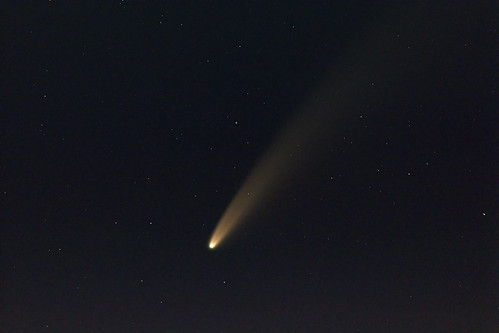
Comet PanSTARRS (stacked)
Comet PanSTARRS, 13 images stacked in RegiStax

And as if that wasn't enough, make a note in your diary for October 19, 2014, because that's when Comet C/2013 A1 (Siding Spring) is due to make a very close approach to Mars - so close in fact, that the possibility of an impact cannot yet be ruled out. If (and that's a very big "if") it did happen, it would be the most destructive event in the solar system since Comet Shoemaker-Levy 9 carpet-bombed Jupiter in 1994 and could have profound effects on the Martian climate. Either way - direct hit or near-miss - it promises to be quite a show.


See also:
Planetary Society: Comet to whiz past Mars in October 2014
Planetary Society: Will comet Siding Spring make a meteor shower on Mars?

Sunday, 17 March 2013

Birds of East Kent: Wheatear

Latest in an occasional series of posts discussing the different birds that can be found in East Kent and how easy (or not) it is to get a decent picture of them.

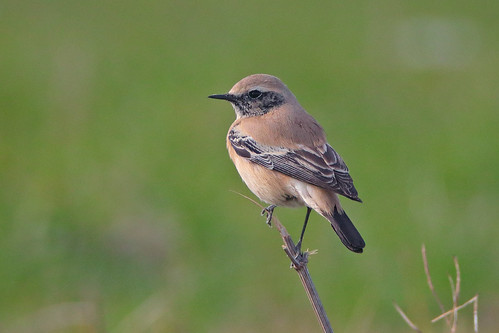
Wheatear
North Foreland, Broadstairs, September 2012

Supposedly named for the white rump it shows during flight (Wheatear = "white arse", geddit?), the Northern Wheatear (to give it its full title) is perhaps East Kent's best example of a passage migrant. We see them twice a year: once in springtime when they stop off on their way to their breeding grounds, and again in autumn as they prepare to make the long journey back to sub-Saharan Africa.

Appearance-wise, they're hard to confuse with any other bird. The spring male in its full breeding plumage is a particularly impressive sight with its dark chocolate-brown wings, blue-grey back, black eye-mask and peach-coloured flush on its breast and throat.

Wheatear (Oenanthe oenanthe)
Bishopstone, Reculver, April 2010

Wheatears are fairly easy birds to locate, as they can be seen just about anywhere along the coast during the peak of the spring and autumn migrations. The rocks at Bishopstone are usually a reliable place to look, as are the scrubby cliff-tops and strips of grass between North Foreland and Foreness.

In some years, if the weather keeps them grounded, they can build up to impressive numbers as they gather along the coast. I remember one autumn afternoon when they were literally popping up out of every bush I passed as I walked from King George VI park to Broadstairs. (I suppose this was the Wheatear equivalent of Operation Stack.)

However, getting close enough to acquire a decent photo requires a little forethought. Although Wheatears spend a lot of their time on the ground, they frequently fly up to the nearest available perch to see what's going on around them. One method (a trick I learned from observing similar behaviour in Stonechats) is to advance quickly while they're feeding and immediately freeze as soon as they fly to their perch. It may take a while, but with practice and persistence you should be able to get very close indeed. Another method is to observe if they're moving in a particular direction and surreptitiously get ahead of them. Then it's a matter of keeping still as they work their way towards you. (And of course not making making the schoolboy error of suddenly raising your camera.)

Wheatear at Viking Bay
Viking Bay, Broadstairs, October 2011

Wikipedia lists 21 other species of Wheatear, a couple of which occasionally make it to British shores. But considering how far these birds travel, it's a privilege to see even the regular ones.

See also:
More of my Wheatear photos on Flickr
Wheatear (RSPB)
Wheatear (Birdforum)
Wheatear (Birdguides)

Saturday, 2 March 2013

The Birds of Bossenden Wood

If Wikipedia is to be believed (and if Millwall vs West Ham doesn't count), Bossenden Wood is the site of the last battle fought on English soil, which supposedly lasted for just a few violent minutes in May 1838. These days the only battles you're likely to see here are between the different species of birds as they fight over the various nuts and seeds that the photographers have laid out for them. Purists might regard this as cheating, but I know from experience (having spent many hours wandering around the larger Blean complex hearing lots and seeing little) how challenging it is to photograph woodland birds, so in this instance I have no qualms in resorting to "bribery".

This is the best time of year to photograph woodland birds, as there is less foliage to block the light. I'd been planning to visit Bossenden all winter but it wasn't until earlier last month that a window of opportunity (and blue sky) arrived. I brought plenty of bird food with me, but I needn't have bothered as the conveniently-situated log had already been well baited. So, all I had to do was take my place alongside the other photographers and snap away. My target species were Coal Tit, Marsh Tit and Nuthatch, and I'm pleased to say I got all three of them - with varying degrees of success.

The Nuthatches were the hardest to shoot, staying only long enough to grab a nut and then fly off with it in their characteristic commando style.

Nuthatch (Sitta europaea)

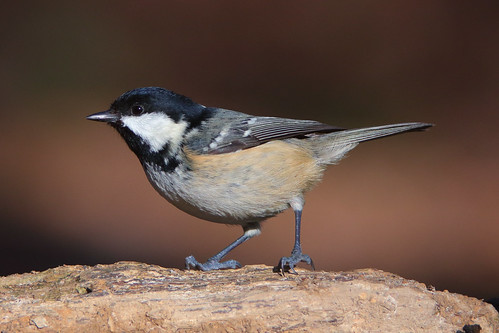
Coal Tits were present in good number and were much more obliging (except when they were chasing each other through the trees).

Coal Tit (Periparus ater)

Marsh Tits were less numerous, and I only really got two or three usable shots.

Marsh Tit (Poecile palustris)

This smart male Chaffinch also got in on the act, and posed so nicely it would have been rude not to take its picture.

Chaffinch (Fringilla coelebs)

And as if that wasn't enough, I also saw Blue Tits, Great Tits, a noisy Blackbird and a group of Long-tailed Tits.

Bossenden Wood also plays host to the red-listed Lesser-spotted Woodpecker. I didn't see one on this occasion (not that was I expecting to on my very first visit), but the show put on by the other birds more than made up for it.

See also:
More of my photos from Bossenden Wood (Flickr slideshow)
Kingsdowner: Bossenden Wood


Sunday, 13 January 2013

Birds of East Kent: Snow Bunting

Latest in an occasional series of posts discussing the different birds that can be found in East Kent and how easy (or not) it is to get a decent picture of them.

Snow Bunting
Palm Bay, Margate, March 2012

The Snow Bunting is a regular winter visitor to Kentish shores, albeit never in huge numbers. They can pop up just about anywhere along the East Kent coastline, but the most reliable place to find them is along the shingle beaches at Reculver, foraging amongst the pebbles.

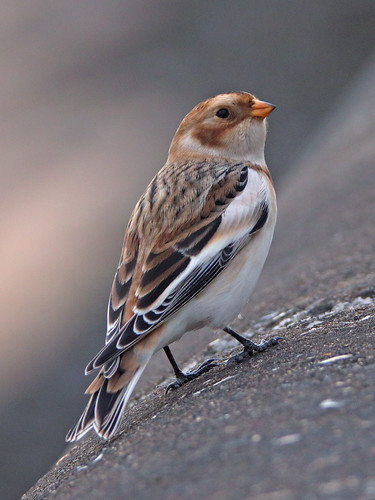
I like to think of this smart little bird as the "photographer's friend" because not only is it very photogenic, it can also be very approachable. But of course, a flock of birds is only as brave as its least brave member, and so the closest you get to a larger group of Snow Buntings (known collectively as a "drift") may be when they fly over your head to the other end of the beach - half an hour's walk in the direction you just came from. However, if you're fortunate enough to find a Snow Bunting by itself (no easy task, since they usually blend in very well with the pebbles) and don't make any sudden movements, it may allow you to get within a few feet. The bird pictured below was so confiding I had to back away just to keep it in focus.

Portrait of a Snow Bunting
Kingsgate Bay, Broadstairs, April 2011

In summer, when they return to their breeding grounds in the high Arctic, the Snow Buntings undergo a dramatic change, with the males turning almost completely white. Here in Kent, they're invariably gone before we see them reach this phase, but if you're lucky enough to catch a straggler you might see the white plumage starting to come through. Compare the difference between the one above (photographed in early spring) with the one below (taken in late autumn).

Snow Bunting
Reculver, November 2009

So the next time you go for a walk along the coast on a bracing winter's day, keep your eyes open for these charming little birds. They may be closer than you think.


See also:
More of my Snow Bunting photos on Flickr
Snow Bunting (RSPB)
Snow Bunting (Birdforum)

Monday, 7 January 2013

Sir Patrick Moore - A Belated Tribute


The final edition of The Sky at Night to feature Sir Patrick Moore aired last night on BBC 1 (and will be showing again as an extended episode on BBC 4 later in the week), so this seems like a timely moment to share a few thoughts I originally posted on the Sky at Night Flickr group a few weeks ago.


Many moons ago, my mum wrote to Sir Patrick, asking him for advice on what telescope to buy her astronomy-obsessed son, and he very kindly sent one of his famous hand-typed letters in reply, offering his usual brand of no-nonsense wisdom.

Years later, after going on to study astronomy at university, I was fortunate enough to attend one of Sir Patrick's BAA lectures at the University of Kent, in which he spoke about Mars for an hour (without notes). It was the period straight after lunch (a tough time to give a lecture), but he kept the whole audience captivated with his energy and boundless enthusiasm.

And just last month, I was watching The Sky at Night on BBC 4 when I was pleasantly surprised to see one of my photos featured in an item about the planet Mercury.

RIP Sir Patrick, and thanks for everything. You will be missed.


See also:
The Sky at Night on BBC iPlayer (available until Sunday 13 January)
The Sky at Night programme page
BBC Stargazing LIVE (starts Tuesday 7 January)
BBC Sky at Night and Stargazing LIVE Flickr page


Wednesday, 24 October 2012

Birds of East Kent: Purple Sandpiper

The second in an occasional series of posts discussing the different birds that can be found in East Kent and how easy (or not) it is to get a decent picture of them.


Purple Sandpiper
Viking Bay, Broadstairs, November 2011

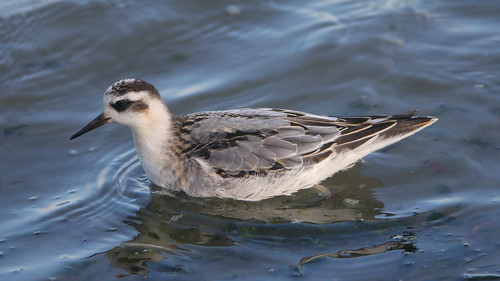
According to the RSPB website, Purple Sandpipers are supposed to be scarce south of Yorkshire, which perhaps explains why some local photographers have been known to risk life and limb (and their camera gear) clambering over wet rocks just to get a photo of one of these birds. However, despite what official sources say, Purple Sandpipers can in fact be found along the Thanet coastline every winter, with the stretch between Stone Bay and Dumpton Gap being a good area to get close-up shots of them. The photo above was taken from the relative comfort (and safety) of Broadstairs jetty.

Often described as "dumpy little waders" in the guidebooks, Purple Sandpipers are slightly smaller and not as bold as the more plentiful Turnstones with whom they share their winter haunts. Their propensity for skulking under the jetty, or creeping furtively along the seawall while picking at the seaweed-covered stone makes them easy to overlook unless you're actively seeking them out.

Distinctive features include a downcurved beak and mustard-coloured legs. The purple sheen that gives them their name is less obvious, but if the light hits them at the right angle, it shows up quite well:

Purple Sandpipers
Broadstairs, February 2010

Don't dismiss these "dumpy" birds; under the right conditions, they can be very photogenic.


See also:
More of my Purple Sandpiper photos on Flickr
Purple Sandpiper (RSPB)
Purple Sandpiper (Birdforum)

Tuesday, 9 October 2012

Ocean of Storms

Oceanus Procellarum

At first glance Oceanus Procellarum (the Ocean of Storms) appears to be one of the less interesting regions of the Moon, presenting to the casual observer nothing more than a vast, monotonous plain of dark grey lava, dotted with the occasional impact crater. But look closer and you'll find evidence of ancient volcanism on a huge scale, unlike anywhere else on the lunar surface.

Here's a 100% crop showing the Aristarchus plateau - an diamond-shaped block of uplifted terrain dominated by the dazzling crater Aristarchus and the 160 km-long Schröter's Valley:


Easily visible in a small telescope, the valley is the largest and perhaps most dramatic example of a lunar rille, a sinuous channel cut (a very long time ago) by fast-flowing lava.

Follow the terminator south and you come to the Marius Hills, a complex of some 300 volcanic domes and hills that - through a small telescope - look like pimples on the lunar surface:


Lunar Orbiter 2 photographed the complex from an oblique angle, giving an idea of the relative height of the domes, and a few decades later the Japanese SELENE/Kaguya mission discovered an intriguing dark pit in the area (shown here in a high-resolution image taken by the Lunar Reconnaissance Orbiter).

Incidentally, if you move your mouse over the cropped images you can compare the finished versions with one of the original photos, illustrating the dramatic improvement that image-stacking can make to lunar photography.


See also:
Procellarum: The Biggest Basin?
Shooting the Moon: Lunar Photography with a DSLR and a Small Refractor